I didn’t start with strategy.I started at the service desk.

In 1999 I repaired computers and set up copiers, printers and scanners at customer sites. Seven years later I was implementing my first large business system — the kind where production, warehouse, sales and accounting all work in the same place. Since then I have implemented such systems in, among others, Poland, Sweden, Spain, the United States and the Middle East.ERP IFS Applications · Business Intelligence · solution architecture · Delivery Management
That order matters. Before I started advising boards, I spent two decades accountable for systems still running at five o’clock on a Friday. So when I talk about transformation, I talk from the ledger rather than the slide: I know what delivering one costs, and where it usually stalls.
Today I own the AI, data and analytics strategy of an international technology group in the United States — as Data & Analytics Manager, since November 2024. I build the team, design the solution and, with that team, take it to the point where it runs in a client’s business every day.
Technical design, running the implementation and leading the people are usually three different jobs. I hold them together — on engagements in the United States, Europe and the Middle East. One person owns the outcome, and there is nobody to pass it along to.Solution Architecture · Delivery Management · Team Leadership
That is why this page is not an archive. What I describe here I test on the projects I am running now — on the tools that are current today, and tomorrow on whatever replaces them.Microsoft Fabric · Medallion architecture · Lakehouse · Direct Lake · Power BI
That path is backed by a diploma as well. An Executive MBA at OBS Business School and Universitat de Barcelona, conferred in July 2026, gave me a shared language with boards: strategy, finance and change management as one coherent system, rather than a set of habits collected along the way. Practice taught me what works. The program made me work out which of it is method and which is instinct backed by experience.
I have run Digital Mentors Hub since 2004, alongside every employed role and longer than any of them. I have taught without a break for over a decade — at the University of Silesia in Katowice (2016–2018), WSB Academy in Dąbrowa Górnicza (2015–2024) and Akademia Górnośląska in Katowice (since 2025). The two feed each other: delivery gives the lecture its material, and the lecture forces me to name what practice does on instinct.
The full path: 1999–2026twelve milestones
-
2024
Data & Analytics Manager Astra Canyon Inc. · Tucson, Arizona, USA AI, data and analytics strategy for the whole group
-
2023
Delivery Manager EPAM Systems a HIPAA-compliant enterprise data warehouse MVP in 20 weeks
-
2020
Project Manager · Solution Architect ProV International field services, telecom and manufacturing — US, Saudi Arabia, United Kingdom
-
2018
Business Solutions Architect InfoConsulting IFS solution architecture and presales — Spain, Sweden, Norway
-
2015
Senior Solutions Manager · IFS Solutions Architect Novacura from management into architecture
-
2014
Director of Business Intelligence Marketplanet BI for a procurement platform
-
2010
Director of BI product & department InfoConsulting in parallel: CRM & BI consultant on IFS projects
-
2007
ERP consultant — the IFS thread begins Proximus S.A. the thread starts here and has not broken since — nineteen years
-
2006
ERP and CRM solution sales · Project Manager WizjaNet the other side of the table: sell it first, then deliver it
-
2005
Engineering degree Lecturer: Mieczysław Jagodziński thirteen years later he wrote one of the recommendations you read below
-
2004
Digital Mentors Hub founded own business running ever since, alongside every full-time role
-
1999
Service desk technician P.H.U. Vector computers and digital multifunction devices
- 79client organizations since 2006 · Poland, Scandinavia, Western Europe, North America, Middle East
- EMBAOBS Business School · Universitat de Barcelona
- 19 yrsin the IFS ecosystem — from consultant to architect
- 11 yrsof teaching · University of Silesia · WSB Academy · Akademia Górnośląska
- 67industry and technology certifications
- Speaker and judgeAI Innovation Challenge · Akademia Górnośląska, 2025
- AIM6™ · DM6™proprietary AI and data maturity frameworks
“The wolf doesn’t shout.
The wolf leads.”
No alpha without the pack.
Mentoring is a conversation, not a lecture. A leader is only as strong as the team — and the reverse is just as true.
A bridge only counts once someone crosses it.
I build the crossing between what a company can do today and what it will have to do tomorrow — and stay until people actually use it.
Technology is only the tool.
The harder part is how people learn to use it — without pretending the company suddenly became someone else.
Where the wolf and the code come from
This site carries Japanese characters, a wolf and a warrior’s code. They look like a design decision. They are not. I chose none of them for the brand. The brand grew around them.
The wolf came first. He has been with me since childhood, long before I could name it. In 1998, at eighteen, I drew him. Not from a template, and not as an idea about myself: he simply came out of my hand. That drawing became my first tattoo. I started working a year later.
The second wolf arrived twenty-four years on. In 2022 I covered that drawing with a new one: reborn, stronger, deliberate. The first was not erased. The new one carries it.
That is exactly the operation I perform for clients. Old systems are almost never deleted. You build a layer above them that understands them and gradually takes over, until switching the old one off stops being a risk. The difference between those two wolves is also the difference between instinct and method. The first I drew without knowing why. The second I chose.
This brand’s mark shows a wolf in profile rather than facing you. A profile has a direction. A wolf looking at you is standing still; a wolf in profile is going somewhere, and you can follow.
The code came off the mat. For over ten years I trained ju-jitsu-based self-defence, Shaolin Kempo and kenjutsu. That last name matters most here: kenjutsu is the sword art of the samurai, and bushidō is the code of those same men. Between the training and the mark at the top of this page there is no metaphor. There is a straight line.
A dojo teaches in a way no slide can reproduce. You repeat a single form a thousand times, and only after the thousandth do you understand why the first nine hundred were wrong. Nobody explains it along the way. You are meant to see it yourself.
One thing I took from there turned out to be entirely professional. A teacher does not stop you when you make a mistake. He stops you when you work carelessly. An error is a stage of learning; carelessness is a decision. Twenty years on, that is exactly how I read somebody else’s data model. I am not hunting for errors. I am looking for the places where someone let it slide.
Those arts are themselves a bridge. Ju-jitsu and kenjutsu grew up in Japan; Shaolin Kempo has Chinese roots. I practised them side by side long before I earned a living joining orders that are not supposed to fit together. The bridge in this brand did not come from a slide about synergy. It came from a training hall where two traditions stood next to each other and neither had to win.
All of it meets at a single point. Kata is a form repeated until it stops being remembered and starts being understood. A data model behaves the same way. You build the first from documentation, the tenth from experience, and by the fiftieth you look at a client’s schema and know where it will break before anyone has run a query. Neither world offers a shortcut. It is the same skill, practised on different material.
That is where Digital Mentors Hub came from. Transformation rarely falls over on technology. It falls over on people who are asked to work differently than they have for fifteen years. Budō is a technology for changing people, and it has several centuries of advantage over any change management framework. Joining those two orders is not decoration on this brand. It is the only idea here that is genuinely its own.
I write about what I do.
Three things that grew alongside the projects: a rulebook for report design, a story about data transformation, and the design system I work with every day.
-
Book
Power BI Design Essentials
A Rulebook for Effective Dashboards · 12 chapters, 63 pages
From design principles and grids through DAX and accessibility to storytelling and governance. A rulebook, not a manifesto: the rules I apply on every engagement and teach to my students.
-
Story book
Data Wolf
An illustrated story · data transformation
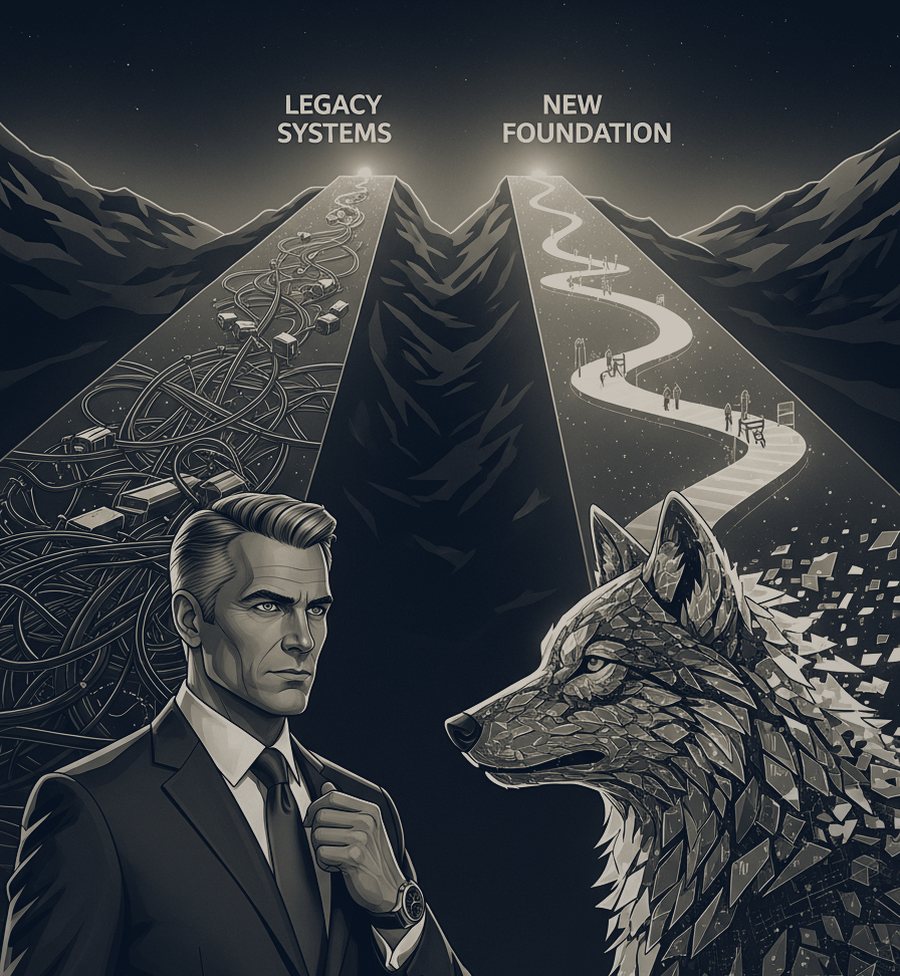
An organization faces two roads: the tangle of systems grown over years, and a new foundation still to be built. A wolf leads the way — the same one that stands in this brand’s mark. I open the class with it, before a word is said about architecture.
-
Product
PowerBIToolBox v2
A Power BI design system · 4 variants, 29 Design Book pages, 1,359 objects
Themes, components and documentation in four variants — light and dark, in two color identities. What I build reports with. I put it in students’ hands so they learn design rather than clicking.
People I walked the road with.
Seven LinkedIn recommendations from 2007 to 2024, plus a letter of recommendation from my direct manager. The three highlighted ones answer the questions boards ask most: does he understand the business, does he deliver, does he lead people.
His proficiency in IFS systems, 3rd party CRM integration, and Data Lakehouse architectures has been instrumental in the success of numerous high-stakes projects. […] His skillful management of project budgets has consistently resulted in on-time, on-budget deliveries without compromising on quality.
Damian worked as a IFS/BI/Qlik Sense Consultant for one of my top clients in France. He was an exceptional consultant to work with. He was able to communicate both the business and technical aspect of the project extremely well and the client could not of been happier with the work Damian produced. Whatever was asked of Damian he was able to complete the task with no questions asked and always bought positivity and energy to every task. I would highly recommend him.
Damian is the epitome of what a engaged architect and project manager and leader should embody. Damian pays great attention to detail and stays on target with the project deliverables and making sure everyone on the team is aligned. Damian has great conflict management skills. Any company is lucky to have him on their team. I really enjoyed working with him on a project.
Damian is an absolute pleasure to work with. His robust communication and organizational skills as well as his commitment to best practice are all evident in the way he conducts himself and manages his team. I'm extremely grateful to have had the privilege of his expertise and leadership on our collaborative project.
Rekomenduję. Skuteczny ekspert z zakresu wdrożeń CRM, ERP i BI w dużych organizacjach.Translated from Polish: “I recommend him. An effective expert in CRM, ERP and BI implementations at large organizations.”Maksymilian Sleziak · Co-Founder, Ageno · 2020Skuteczny Wizjoner, posiada ogromną wszechstronną wiedzę biznesową w zakresie BI.Translated from Polish: “An effective visionary, with vast and wide-ranging business knowledge of BI.”Mieczysław Krzysztof Jagodziński · Dyrektor ds. Rozwoju i Szkoleń · 2018Very professional, independent, oriented to the final product, substantive, supported methodology cooperation in the areas of Business Intelligence, Software Development, Analytics.Radosław Sobczak · System and Business Applications Manager, Group Com40 · 2016
Very good results.Przemysław Małecki · Company Owner · 2007
Foreign-language quotes appear verbatim, each with a translation underneath — the original stays, because the original is the evidence. Seven LinkedIn recommendations and the ProV International letter. All recommendations, with links to their authors’ profiles, are on my profile: linkedin.com/in/damian-skipiol.